- The Learning Lab
- Posts
- The Harsh Truth about Spaced Repetition

Upcoming Event:
On June 6th at 8:00 PM EST, I’ll host my first ever 90 minutes long free education panels with Hope Paterson.
The purpose is to showcase ambitious teens at Alpha X, how they learn with global educators.
We’ll have:
Interactive breakout rooms
Listen to stories from our ambitious teens
Problem solving sessions between students and educators
If this sounds interesting, you can register below:

Read time: 15 minutes
Listen to the newsletter here:

I went from being a slow learner to a good learner after learning the one simple technique of thinking. I couldn’t believe how simple it was. I’ll tell you the tricks so you don’t waste a day jumping rabbit holes
The technique: Spaced repetition
Before you close, this is not your usual advice from learning influencers.
Until December, I never learned how to learn before.
YouTube vides, blogs, articles were my friends. Everyone talk about spaced repetition + active recall like the holy grail.
But after 6 months of experiments and practice.
I found harsh truths you must know, to learn faster and stop wasting time
This newsletter outline:
What is spaced repetition?
What problem is it solving?
Why is it inefficient?
What other solutions do we have?
Actionable takeaway?
What is spaced repetition?
80/20 of spaced repetition: Your weapon against the forgetting curve. Lens to find knowledge gaps to relearn later.
From now I'll refer to it as SR to save time.
SR spaced out your learning instead of a chunk.
If you learn X today, you might have revision 1 day later, 1 week later, 1 month later...Those are interval.

What do you do in your SR?
Active Recall (AR) is refer as the twin brother of SR.
AR is your tool to find you knowledge gaps.
The common tools:
Flashcards
Feynman technique
Practice questions
But let me clear up some confusion first...
Effective AR achieves 3 purposes:
Time efficient: Doing something to save time in future
Effective - Fast at finding knowledge gaps
Relevant to the type of mastery you are aiming for.
Mastery - The fluidity of how you can use that concept in different scenarios.
Higher levels of competence = More unconscious excellence.
The goal of your SR and AR is to quickly find your knowledge gaps so you can relearn them.
The problem with relying on SR + AR:
Infinite learning time: If you don't encode it properly, you'll be revising FOREVER.
Non-scalable: No matter how hard you try, it is impossible to have 25 hours/day
How effective is it at finding your knowledge gaps?
So the question right now, how do we actually use AR and SR in our learning system:
First the learning system has 3 parts:
1. Encoding -> Process information into your brain
2. Retrieval -> Recall information to find what you forgot
3. Re-encode -> Encode what you've forgotten.
While it takes months or years to improve encoding, retrieval is straightforward.
Hence, we will focus on improving this aspect.
Effective AR follows the following principles:
1. Engage in HOTs and avoid LOTs
2 concepts you must understand:
Bloom Taxonomy: When you analyze and evaluate, you fill memorizing and understanding.
Solo Taxonomy: More connections = Better knowledge structure = Better understanding of concepts.
Bloom Taxonomy is the tool that creates the Solo Taxonomy
Applying these two will help you get:
More effective + time efficient
Better memory about concepts
More enjoyable and active process
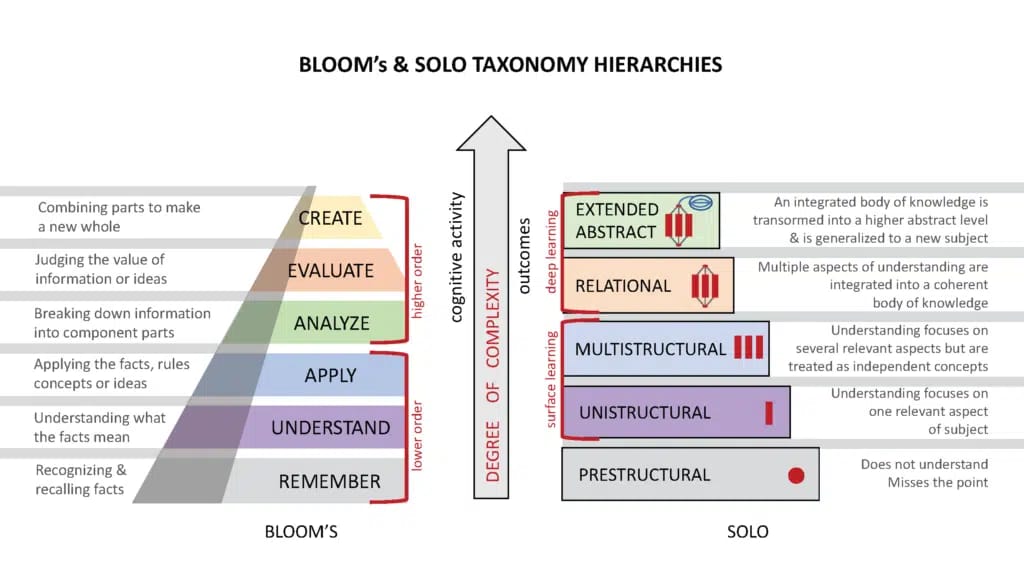
Diagram of Bloom’s vs SOLO taxonomy, original from https://www.structural-learning.com/post/what-is-solo-taxonomy (retrieved 31 May 2023).
2. Test your weakness:
Even with amazing encoding, you will still forget things.
Find your weakest link in your knowledge. If you stumbled, or get stuck for any reasons, that's a sign of forgetting.
And SR and AR are the net that would catch the knowledge for you to re-encode.
3. Use interleaving
One of the most studied field of learning science. When you mix up your learning, use different techniques, you gain a better understanding of the world
Interleaving is approaching your knowledge from different angles...
This help your brain build context and meaning for the word.
Example:
If you are learning mandarin Chinese, interleaving would be using different techniques:
Flashcards for keywords
Immersion learning - talking to strangers
Creating practice scenarios - training your procedural knowledge.
Create practice questions that ask about the relationships of concepts.
Like we recall, the best AR methods test you at a HOTs - lots of evaluating, contrasting, and judging the concepts.
(Integrated knowledge > Isolated knowledge)
Any retrieval practice that make you think and test concepts at a higher level, is deemed to be effective.
Here's an incomplete list of techniques for your interleaving:
Teach an imaginary student
Draw a mindmap
Draw an image instead of using words to find a visual way of expressing information
Answer practice questions
Create your own challenging test questions
Create a test question that puts what you’ve learned into a real-world context
Key takeaways:
Aim to learn better - You can't remember something you haven't learned
In the last 6 months, I have been obsessed with metacognition ~ AKA learning how to learn
After 127+ hours of practicing and improving my techniques
I found 3 simple questions that helped me learn basically anything faster, and easier:
— Toan Truong (@LearningToan)
1:45 PM • May 27, 2023
Use more efficient interleaving methods for spaced repetition
1. Interleaving (Brunmair, 2019)
Instead of mass practice. Mix up your learning methods.
- Flashcards
- Scenario plays
- Teach someone
- Practice questionsEach scenarios give you different context and referencing points.
The goal: give it context
Here's an example ↓
— Toan Truong (@LearningToan)
3:10 PM • May 30, 2023
Test your weakness with higher order learning, find knowledge gaps with Bloom Taxonomy, and re-encode.
https://twitter.com/LearningToan/status/1625940644186161152?s=20
Final Takeaway:
Spaced repetition by itself is not enough. In order to become a more efficient learner, you will need:
Higher order learning (Bloom + Solo Taxonomy)
Interleaving practice
More emphasize on improving the quality of encoding.
That’s a wrap! 🎉
Thank you everyone for taking the time to read this!
If you liked this newsletter, reply with “YES“ so I can write more about this topic.
If you have any other specific queries or topic you want me to discuss, please tell me. I reply to all your messages.
P.S. Recently I got interviewed by Hope about my view on the effects of social media for teenagers, if you’re interested, you can watch it below: