- The Learning Lab
- Posts
- How to remember every YouTube video you watch. Pt 1
How to remember every YouTube video you watch. Pt 1
A counterintuitive approach.

Toan Truong
May 21, 2023
Read time: 5 minutes
Practice time to mastery: 3 hours
Key action steps:
Problem → Transcript → Keywords → Questions → Knowledge web.

Most self improvement consumers nowadays are mindless scrollers.
Which explains why people can spend 2 hours listening to podcast, and not remembering a single idea from it.
Fundamentally, there are a few problems with these approaches:
You have the illusion of learning
You are not making the information memorable
You are forcing the information down your throat
The usual solutions:
Let's watch it again
Let's make flashcards
Let's write down everything
If this is you, congratulation! 🥳
You have successfully wasted a lot of time.
With this updated system, you can expect the following results:
More confidence and curiosity when learning
No more (much less*) flashcard, rereading, rewatching...
Remember something longer and build strong thinking brain.
Before we start, I must give you a warning…
In the beginning, the original:reality learn time will be around 1:3
AKA: 10 min video = at least 30 min learning
But with better fluency = Lower time spent learning.
This method follows the following learning principles:
Order control
Priming the brain
Inquiry Based Learning
Importance based chunking
Don’t worry if this sounds weird. I will explain them soon. 😜
To visual this, think of this analogy:
"You can't fill a leaking bucket by adding more water."
Leaking bucket = The way you learn
Water = More videos, flashcards, notes, rewatching, rereading

⚠️ Important ⚠️
This topic will be covered in 2 weeks. This week and the next one.
This week: Theory and rough instructions.
Next week: Implementation and demonstration.
I decided to split the newsletter into 2 because I want you to practice the skill, make mistakes and see your flaws before I show the possible mistakes.
Let’s begin 🎏
1. Identify the problem you are want to solve.
If you attach your learning to a problem, it becomes more important for you. Which as results make what you learn more memorable.
Brainstorm the problems you have and ask multiple “why“ questions to find the root cause of the problem.
2. Find at least 2 videos that might have the answer.
There is a phenomenal called synoptic reading (watching)
When you watch 2 videos in parallel, you can simultaneously compare and contrast the points together → Forming more connections, and find patterns.
It'd be nice if you can find videos from different POV, so you get the most holistic angles.
Rule of thumb: The videos with most likes don’t always correlate with the most valuable advice.

3. Download & reorganize the transcript
Open the transcript.
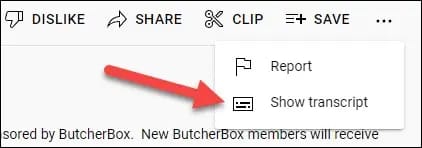
Paste it into ChatGPT to re-format for clarity.
Prompt: “Reorganize this transcript for clarity with markdown format and headers”
Paste into a google docs.
You would get something like this:
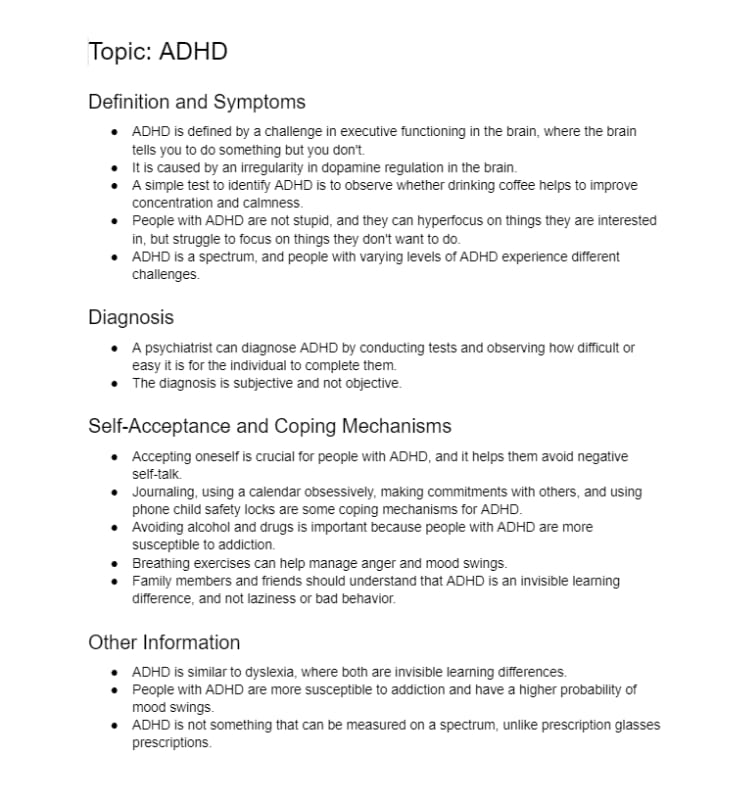
4. Generate curiosity
Learning is a constant cycle of creating and fulfilling curiosity.
From your list, write down the questions you are curious.
Remember: 1 Question → Multiple Answers → Relationships → Evaluate Quality → Form Chunks
The best questions to form connections are:
Why is this important? (make it personal)
How is this related to everything
What problem is this solving?
Repeat this for as many keywords/ key concepts as possible.
Repeat until you find a logical and intuitive 3 - 4 ideas that could summarize the main points of the topic.
Now represent it on a piece of paper or a digital canvas.
(Use arrows, visuals, bolded words, doodles to show relationships)
Don't overthink this.
This step is here to form some basic connections and become curious about what you are about to learn.
The chance of getting this wrong is 100%. 😉
Give it a shot, and reply to me with your practice notes.
Next week I will show you the example.
Hint: imagine a spider web, or a flow chart.
5. Fulfilling curiosity
Instead of watching from beginning to end.
Jump around
Remember: Create curiosity → Fulfil curiosity → Create → Fulfill… Until you master the concept.
You can use “Ctrl + F“ to find the answers on your google docs.
Or look up the answers in ChatGPT.
Information in any form is still information.
Once you answer a question, take your time to think about the relationships and how to represent it in your mindmap.
Don’t delegate this to AI.
If your map becomes messy and weird, draw a new one.
Repeat this process until you answered your most important questions.
🛝 Practice time:
Identify the problem you want to solve
Identify 2 - 5 videos that potential have the answers.
Create curiosity → Ask questions → Forming the backbone.
Fulfil curiosity →Answering questions → Representing through a mindmap.
Continue the cycle of step 4 → 5 until you feel like you “masted“ the subject.
This process sounds complicated.
But once you master this system you can use it for all forms of learning.
Information will always be information. No matter the delivery. You can still learn it the same way.
CTA:
Take 15 - 20 minutes to practice with this system. Then reply to me with what you created. 😁
I don’t run ads for this newsletter. So if you want to support this newsletter, share it with a friend. (We are 20 subs away from 1000 🫢)
Reply to me what you want to read more about, I’ll reply to every message.
P.S. And let me know what you think about the Loom too. It’s a new experiment.
Disclaimers:
I am not a learning coach.
I don’t have the perfect system
I haven’t experienced it with learners
I haven’t dived into the research paper and theories
My learning techniques are based on my experience and the *limited research that I have done.
Please consult with a professional learning coach for better information. 😉