- The Learning Lab
- Posts
- A Note-Taking Masterclsass
A Note-Taking Masterclsass
How to take meaningful memorable notes while writing less

Toan Truong
April 09, 2023
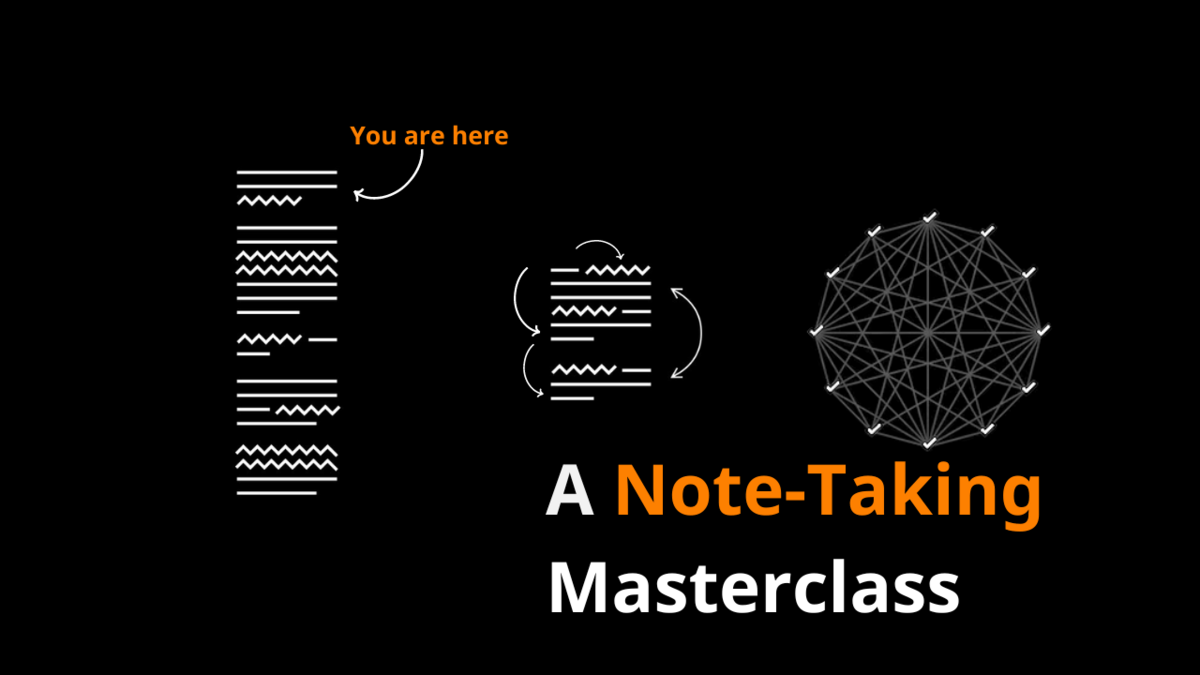
Welcome to the Masterclass, brave scientist!
Reading time: 7 minutes
Taking notes is an essential part of the learning process.
Not only do they help you keep track of your ideas and research, but they are also great for flexing on TikTok.
However, the way most people take notes is ineffective and most of the time worthless.
So in this mini masterclass, I will change your mindset about note-taking, so you can write fewer notes without forgetting what you wrote.
We will cover:
The purpose of taking notes
Where most people screw up
The principles of effective notes
The 3-level system to upgrade your notes
Let’s begin 🚀
The purpose of note-taking
There are mainly two purposes for taking notes:
A place to hold your information.
A way to represent how your brain thinks.
If you can get these two right, then everything else is just supplementary.
A good note-taking system will help you:
Remember what you learned.
More clarity for your learning process.
Help your brain visualize the information.
The 6 principles of effective notes.
Before we upgrade our note-taking system together, we need to learn some core principles.
Take 4 minutes to read this part, and everything afterward becomes much easier to understand.
Principle 1: Keywords, not sentences:
Instead of copying an entire sentence. Only write what is important and needed.
Your brain is not great at remembering sentences, but it’s great at remembering relationship
Principle 2: Personalize your notes:
Your brain is selfish. If something isn’t important or relevant, it’s forgotten. That’s why you must think about what you learned and connect it with your personal experience.
Why is this important for me?
How can I apply this in my life?
What problems can I solve with this?
Think of your notes as your phone wallpaper.
If you can personalize your wallpaper, why can’t you personalize your notes?
Principle 3: Think critically and actively
Rather than mindlessly copying information, take a moment to think about it first.
Ask yourself why it is important and how it fits into the bigger picture.
Principle 4: Look for relationships and connections
Find connections between concepts to solidify the connections inside your head.
Think of your knowledge as a spider web. The denser the web the more mosquitos you will catch.
Ask these questions to form relationships:
Why is X important?
How does X relate to Y?
Why is this relationship important?
By actively asking questions like this, it forced your brain to see the bigger picture and engage in higher-order thinking (HOTs).
⇒ Good for understanding and retention of concepts.

Aim for the higher-order of thinking.
Principle 5: Prioritize symbols, arrows, and visuals
Only use words when necessary.
If not, use arrows and visuals to represent the relationship between information.
Later in this newsletter, I will teach you how to create mindmaps to engage in this. 🤫
Principle 6: Written notes are always better than typed
I must introduce you to the concept of Cognitive Load Theory (CLT). I’ll make it short.
Basically, the more overwhelm, and anxious you feel, the more you learn.
📈Overwhelm feeling = 📈Learning
P.S. CLT is good for you, but too much will give you cognitive overload. So instead of jumping from level 1 notes to level 3 notes, gradually improve your mental tolerance.
That’s why when you type something, your learning is almost minimal friction. That’s why you can write 10 pages of notes and not remember a single idea.
→ Hence, written or drawn notes are the best.
You can use pen and paper to get started, but it’s best if you have an iPad or just a digital canvas. 🎨
Common mistakes with note-taking:
🙍 “I write notes linearly (like a book)”
🕺I write my notes like drawing a spider web.
🙍 “I type things out because it’s easier”
🕺I write my notes by hand because I’ll remember more.
🙍 “I just write my notes first and I’ll learn it later”
🕺I critically think about what I am writing before I write.
🙍 “I am writing the notes without actively listening“
🕺I listen first, then think about it, then start writing it down.
🙍 “I don’t think about how different concepts relate together“
🕺That’s exactly why you need the 3 levels system below 👇️
The 3 levels system to upgrade your notes
I have documented the entire process on this Notion page.
You can take a read, bookmark, or duplicate the page 👉️ Here
Action steps:
An iPad or tablet with a stylus would be the ideal combo, but all you need is a pen and paper (no line papers are best) to get started.
Here’s the step-by-step process to improve your notes:
Access your current/latest notes.
Identify which level you are probably at.
Read the action steps for that level
Practice with replayable/pausable resources (Youtube videos, Wikipedia pages, textbook…)
Track your progress and reflect on the note-taking principles.
Final Takeaway:
Your note is a representation of your thinking and processing. By practicing this type of note-taking system, will help you:
See everything you learn as a knowledge web.
Remember what you wrote while writing less.
Make the learning process enjoyable again.
I hope you enjoyed this newsletter. But more importantly, implement the changes to improve your notes.
Personal Notes from Toan:
Right now, I am working on a Note-Taking Masterclass giveaway on Twitter. The course is about 80 - 90% done. Here’s the BTS for any curious individuals.
Here’s the masterclass I am building on Notion
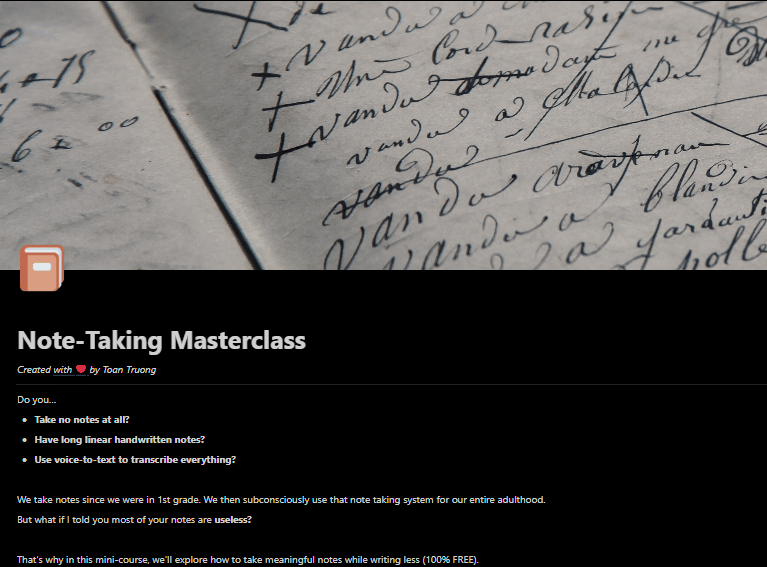
Here’s the masterclass on Notion
I also created this banner for the masterclass. Any thoughts?
I also created this banner for the masterclass. Any thoughts?
What is my plan for next week?
Continue doing the simple repetitive activities as usual. Improving my learning techniques, getting experts to review my work, and sharing it on Twitter.
I am really proud of the visual above, and I completed my website too!
It’s not that fancy yet, I am glad I just got it done. → Learningtoan.com
Some more updates from this week…
I updated my banner, bio, and website link on Twitter. I bought Twitter Blue, let’s see how that goes 😏
I updated my banner to broaden my niche to help all lifelong learners 👇️
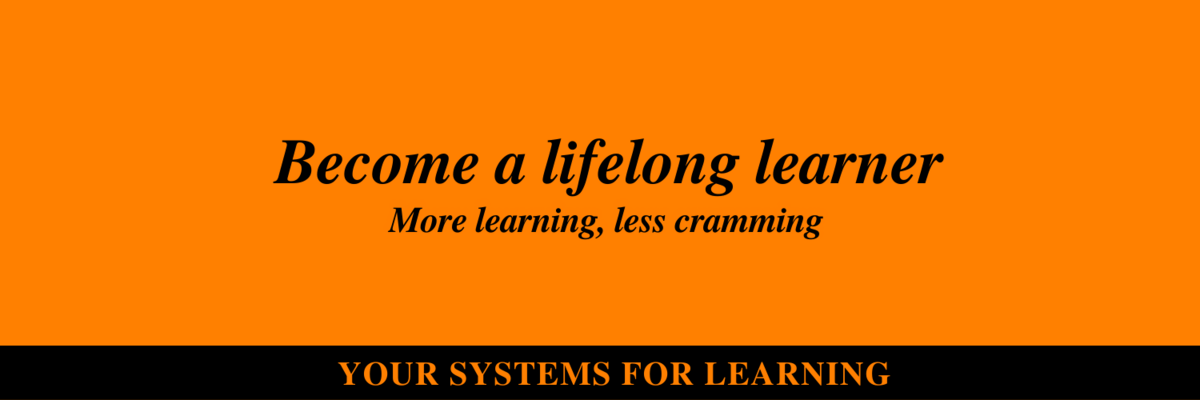
I updated my banner to broaden my niche to help all lifelong learners 😄
That’s it for today!
I hope you enjoy this new format. If you have any feedback for me, just hit ”Reply” and send me a message. I’ll respond ASAP 🙂
Enjoy your Saturday with your family and remember to implement this new note-taking strategy whenever you learn anything new.
See you next week, lab partner!
Written with ❤️ by Toan Truong