- The Learning Lab
- Posts
- If you suffer from procrastination, open this
If you suffer from procrastination, open this
6 tips to gain back your life and do what matters.

Toan Truong
March 19, 2023
Read time: 6 minutes
As a student, it can be challenging to stay productive and motivated for your studying.
Procrastination can easily stand in your way and stop you from achieving your goals. But with the right mindset, techniques and toolkit, you can conquer them
In this article, I’ll share 6 practical tips to help you beat procrastination and actually get shit done.
From creating a plan of action to creating your MVA, these tips will help you stay focused, motivated, and productive - while having time for meaningful things.
So, if you’re ready, here are the 5 practical tips. Let's dive in.
Set SMART Goals:
The best way to attack procrastination is to know your end goals. If you’re not familiar with SMART goals, here’s what they are:
Specific (simple, sensible, significant).
Measurable (meaningful, motivating).
Achievable (agreed, attainable).
Relevant (reasonable, realistic and resourced, results-based).
Time-bound (time-based, time-limited, time/cost limited, timely, time-sensitive).
In recent years, professor Rubin has also added 2 letters which are E for Evaluate and R for Review.
Here are some examples:
Achieve a high GPA: Increase my GPA from 2.5 to 3.5 by the end of the next academic year by attending all classes, completing all assignments before the due date, participating regularly in study groups, and meeting with my academic advisor every semester to review and evaluate my progress.
Improve reading skills: Improve my reading speed and comprehension by 25% within the next six months by reading at least one book per month, using an online reading speed and comprehension program for 30 minutes each day, and tracking my progress weekly to ensure I am meeting my goals.
Improve math skills: Improve my math grades from a B to an A in the next semester by completing all assignments on time, studying for at least 30 minutes per day, meeting with my math teacher once a week for additional support, and taking practice exams regularly to assess my progress. Evaluate my performance after each exam, adjust study habits as necessary, and aim to achieve a score of at least 90% on every exam.
Find your Minimum Viable Action (MVA)
We procrastinate because we feel overwhelmed. For most people, the hardest part is just getting started.
For example, studying 100 pages in 2 hours seems like an overwhelming task for most people.
So let’s break it down.
From 100 pages to just 50, 25, or even 1 page.
But we don’t stop there.
To finish page 1, there are probably 10 mini steps you need to take.
For example, you are binging Netflix and you realized that you have work to do.
Here are the steps you may take:
Look away from TV → Lean backward → Look around you → Breath for 3 seconds → Turn off TV → Stand up → Drink water → Walk to desk → Take out your notebook→ Sit down → Read 1 word → Read 1 paragraph…
The key is to make the action so small that someone could do without any willpower.
Here’s a good article if you want to learn more about MVA:
Create A Schedule (and Stick To It):
Once you have your goals broken down, you need to create a schedule to get things done.
Here are my 2 quick tips for scheduling:
Schedule the non-negotiable first (the must-attend, events, meetup)
Overestimate the task length (if you think it takes you 1hr, put 1hr 30)
Having time before bed to briefly reflect on your day is crucial for me.
Nothing fancy, 5 - 10 minutes of journaling and reviewing my different productivity apps.
I use Google Calendar, Reclaim, and Amazing Marvin for all of my task management and scheduling.
My workflow is in this free Notion page for you:
Eliminate Distractions:
When it’s time for deep work, it’s important to mute your surrounding.
Put your phone in a drawer. Use tab blocker - e.g BlockSite to block destructive websites (Yes, even Twitter)
My friends and family hate me for this, but my phone is always in “Do Not Disturb” mode.
Turn on the fan, throw on headphones, and use Brainfm music (not sponsored).
Let’s start working.
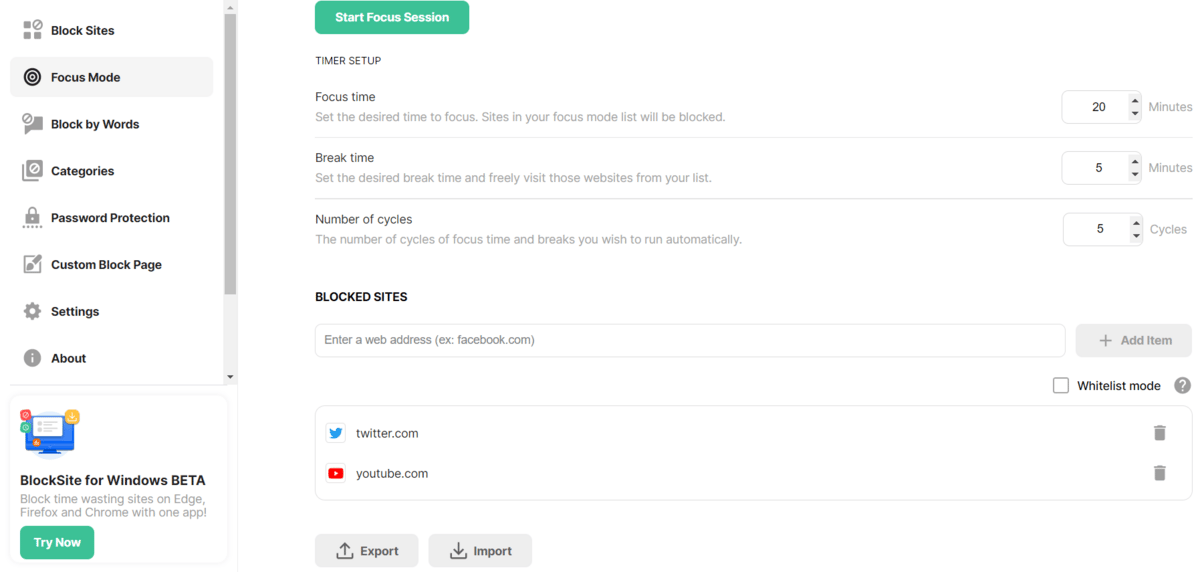
Blocksite - block your distractions.
Active Prioritization:
Not all tasks are born equal. That’s why students can be busy without getting anything done.
So when I do my tasks dump (everything out of my brain)
I ask myself this one question:
“What are the 1 -2 things I could do that would put me in a better position?“
Now schedule these 2 tasks first. Remember to overestimate the length of the task.
Use Time-Management Techniques:
What is the point of all these tips if you don’t work? At some point, you must do the work. The sooner the better.
So get yourself a Pomodoro Timer. I set a Pomodoro timer to 25 minutes of work before a short 5 minutes break.
Avoid social media and distractions during your break. This is your recharge.
You don’t have to complete everything in 1 session.
You can always space it out.
The 6 steps above are how I plan my day as a full-time university student and content creator.
One Last Tip:
As you complete your tasks, celebrate your quick win! High-five someone, do a dance, or write it down,
As you reach more goals, you feel even better about yourself and this will push you even more.
It’s an addictive drug, but it’s good for you.
When you see the small wins, you stop procrastinating.
Congrats.
That’s it. See you next week.