- The Learning Lab
- Posts
- Cramming mindset is the secret sauce?
Cramming mindset is the secret sauce?
The untold power of cramming effectively.

Toan Truong
July 03, 2023

Read time: 7 minutes
Welcome back, 1083 readers, to the Learning Lab.
A weekly newsletter that helps you build your learning systems and become lifelong learners
(P.S. if you don’t have an upcoming exam, just sign up for this newsletter and come back later.)
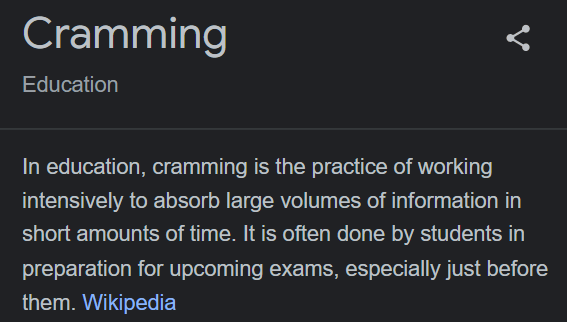
Let's be honest. If you're a student, you've crammed for an exam before.
But
What if I told you that cramming is actually great for you?
yep. That is right.
Cramming, when done right, is highly effective for increasing productivity and retention of knowledge.
Let me explain:
1. When you cram, you force your brain to focus on one thing.
You understand the consequences of inaction, aka falling classes, which makes learning becomes the priority for you.
When your learning has a purpose, it's more memorable.
2. Cramming encourages you to become efficient with your time.
You know the exam is close.
And you know that you’re not going to make it if you don’t study.
But what can you do when you only have a few days or even hours left?
You need prioritization, and highly efficient learning is needed.
So this circumstance forces you to answer two questions:
What should I study to get the best score with my limited time?
And how should I approach my studying for this information?
Now, with a clear problem, here are three ways to effectively cram:
1. Learning in Layers
Our new learning process will be intentional chaos.
Instead of learning from page to page, we’ll jump around.
Think of knowledge as a tree. If you were pruning a tree, what would you prefer?
A tree with a small trunk but thousands of leaves, or a tree with large chunks but only a few leaves?
Which is more stable and sustainable?
Elon put it best:

Most students start learning irrelevant details while their basic structure is crumbling.
Great, Toan, so how do we use this?
So first, you must know that there are four different levels of knowledge in the knowledge tree:
Logic: The basic big-picture understanding of the topic
Concepts: The what and how that explains the logic
Important details: Any details that help provide better perspective on the concepts
Arbitrary details: things that might be important but are not useful right now.
Our goal is to spend 70% of our time in the logic stage and as little time in the arbitrary detail layers as possible.
Here is how:
Very quickly, skim through everything you might need to learn, find anything that you think might be helpful, and then map it out.
⭐ Think about why something is important, and how the different concept relate.
70% of the most important concepts are here.
By prioritizing your material, you ensure that you are focusing on the most important information.
Build the trunk before picking up the leaves. Not the opposite.

2. Find the knowledge gaps quickly
Think like the examiner
If you have to access past papers, use them.
And now think like an examiner,
What patterns of questions appeared in past papers?
How will your knowledge be examined?
Instead of passively answering questions. Here is our new way:
Try to solve a problem; if you fail, ask yourself:
What about my approach makes me prone to making this mistake?
What about my approach makes me prone to making this mistake, and what can I do to avoid making this mistake in the future?
Why?
Because if you take the time to follow these steps instead of;
1 question to solve 1 question,
1 question solved now helps you avoid 5, 10, or 15 different variations of questions.
Once again.
Practice questions use reinforced logic Practice questions use the reinforced logic structure you created.
Test Yourself
There are a lot of ways to test yourself.
If you have practice questions, go ahead.
If not, teach a wall or use group sessions.
The goal is to find what you forgot, note that down, and prepare to relearn.
We will constantly jump between learning, retrieving, and re-learning.
Think about the problems and patterns you are solving:
Another tip is to put on your problem-solving hat.
What problem does this concept solve, and how will it help me in my life?
Think deeply about the application and how you can use it in your life.
This gives your learning purpose and increases the retention of knowledge.
3. Double down on your logic structure.
Yes. This is point #1.
But I just want to reinforce this for you.
Just understanding how everything is related and why it's important goes a long way.
If you are still confused, watch this video here:
Use Memory Techniques
We can use memory techniques for the minor administrative details, but this should be our last resource.
Anki, flashcards, spaced repetition— you are running low on time, so avoid these.
Most of the learning is done when you design the logic backbone.
Once that is done, you have a very high chance of passing your exam.
If you are still seriously confused, give this a watch:
🎯 Takeaway
Look, if you have an exam and you haven't prepared,
Drop everything and start your prep.
Cramming forces your brain to focus on what matters most, and cut through the noise.
Focus on actually understanding the concept, and as a result, you will remember it.
Cramming when done right, is highly effective.
Use the technique I mentioned, and I wish you luck.
🧠 Brain Puzzler
(A question, riddle, or conundrum to mull over.)
What makes this number unique: 8,549,176,320?
Last week, Clara and Mr Hoorn were both very closed to the answer.
“What makes this number unique: 8,549,176,320?”
The answer is: Each number is ordered in alphabetic order 😉
Shoutout to Clara and Mr Hoorn for
🫣 Life Update
The most interesting things about this week
It was a weird week for me, I wrote this newsletter late into Saturday, and edited it on a car trip with my family members. Summer hasn’t been my best friend. But in general, things are going great.
I have some important meetings next week; I’ll share more about this in the coming newsletter.
I completed my Atomic Habits books, but I haven’t been consistent with the other books. I still have time, and I’ll get myself back on track.
Just 30 minutes of reading/day + Some special techniques for reading.
My plan for next week
Focus my time and effort on improving my Icanstudy learning skills. I really need to reach Ascent 3. (If you know you know 😉 )
Schedule all tweets and threads for the next 1 - 2 weeks.
⚠️ Disclaimer
I am not a learning coach yet..
I don’t have the perfect system
I haven’t experienced it with students.
I haven’t dug much into the research paper and theories
My techniques are mostly based on my experience and the limited research that I have done.
Please consult with a professional learning coach at Icanstudy for more assistance. 😇
👉️ If you think someone might enjoy this newsletter, any forwards would be appreciated 🥰